


Story
Moving Forward
Maintaining independence, connection
and enjoyment through mobility
When Associate Professor Taylor Dick talks about movement, she is not just talking about muscles and mechanics. She is talking about independence. About quality of life. About helping people living with MND spend more time doing the things they love.
.png) Associate Professor Taylor Dick with study participant Rob Taylor
Associate Professor Taylor Dick with study participant Rob Taylor
As Group Leader of the Neuromuscular Biomechanics Laboratory at the University of Queensland, Taylor leads a multidisciplinary team of engineers, clinicians, and mathematicians working to better understand how movement changes throughout the progression of MND.
Movement is fundamental to this disease. As the nerves die, muscles weaken, and people gradually lose the ability to move independently. If we can preserve that independence for longer, even in small ways, that can have a huge impact.
Her work recently received an important boost through an MND Australia Innovator Grant, supported by MND South Australia, helping her team explore new ways to monitor movement, improve mobility, and support independence for people living with MND.
Unlike many researchers in the field, Taylor did not come from a neuroscience background. Her expertise is in biomechanics, the study of how the body moves.
“Biomechanics is where physics meets biology,” she explains. “I’ve always been fascinated by movement and how movement changes with health and disease.”
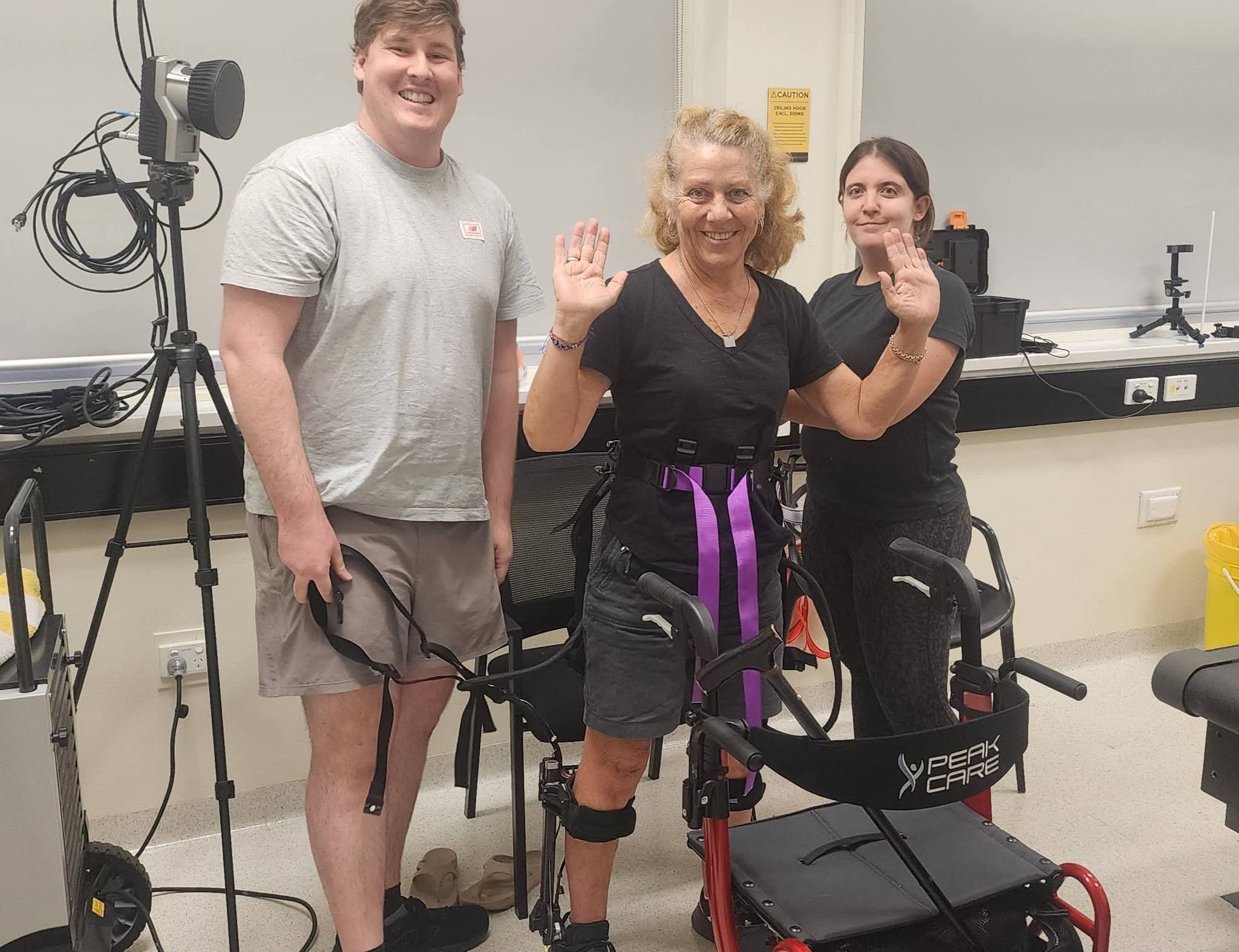 Study participant Heather Burns experiments with some of the movement technology
Today, her lab studies subtle changes in walking, balance, coordination, and fatigue that often emerge early in MND. Using advanced treadmills, motion-capture technology, wearable sensors, and muscle monitoring systems, researchers can analyse movement in remarkable detail.
“We can see how someone’s walking changes from week to week, month to month, and across different stages of disease,” Taylor says.
The research has several goals. Understanding movement changes may help improve earlier diagnosis of MND and provide more sensitive ways to measure whether treatments are working in clinical trials.
But for Taylor, the work is equally focused on preserving quality of life. Her team is also exploring technologies such as robotic exoskeletons designed to support movement and reduce fatigue.
“For some people, technology like exoskeletons may help extend the amount of time they can spend walking, moving, or participating in activities that are meaningful to them.”
Importantly, people living with MND have been involved in shaping the research from the very beginning.
Helping to guide the project as coinvestigators are Janet Hough, a former physiotherapist living with MND, and her husband Peter, who is also a retired physiotherapist.
Janet is also a member of MND Australia’s National MND Lived Experience Network (LEN) and the Lived Experience Research Advisory Panel (LERAP), helping ensure the perspectives of people living with MND remain central to research and policy discussions.
Janet has accessed and embraced a range of technologies to help her continue doing the things she enjoys. She uses an electric trike to stay active outdoors and a treadmill with a built-in harness system to walk safely at home.
For Taylor, seeing Janet explore and apply different movement technologies has reinforced the importance of designing research around real lives and real goals.
“It’s not simply about mobility for mobility’s sake,” Taylor says.
“It’s about helping people maintain connection, enjoyment, and participation in everyday life.”
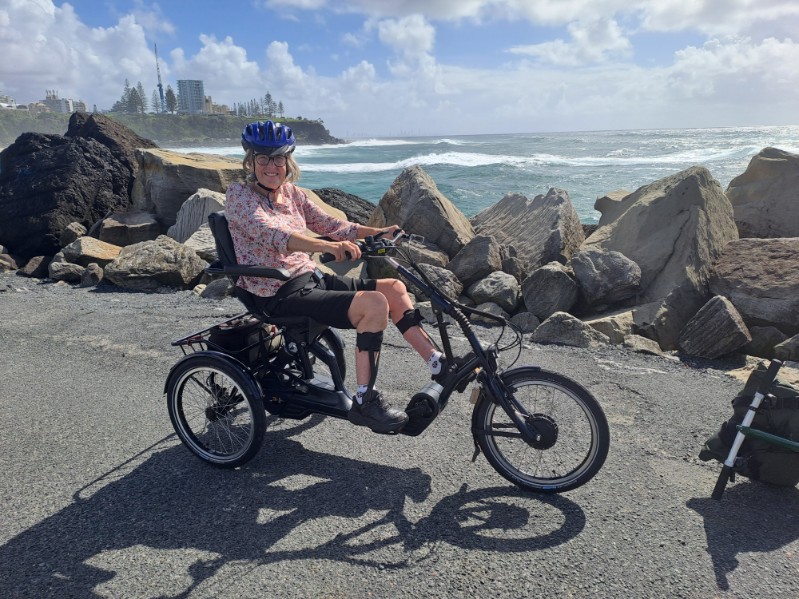 Study co-investigator, Janet Hough, who lives with MND, on her modified trike.
Recently, Janet and Peter travelled from Melbourne to Queensland to visit Taylor’s lab. During one discussion, Peter offered a perspective that reshaped Taylor’s thinking about the goals of her research.
“My original dream was always to help people maintain independent walking for longer,” Taylor says. “But Peter said to me, ‘If technology can help someone do more of what they love for a period of time, then you’ve achieved your goal.’ That really stayed with me.”
For Janet, that means continuing to stay active outdoors, spending time at the beach, and keeping connected with her grandchildren.
“That conversation completely changed my thinking,” Taylor says. “This research isn’t just about movement itself. It’s about preserving the things that fill people’s cup.”
Looking ahead, Taylor hopes movement research becomes a much larger focus within the MND research landscape.
“Finding a cure is absolutely critical,” she says. “But improving quality of life right now matters too. If we can help people maintain independence, participation, and connection for longer, that’s incredibly meaningful.”
This article was originally featured in Issue 3 of Momentum magazine. Read the full magazine here.