


Story
More than a Data Point
Seeing the real lives and experiences
behind the data
For more than two decades, Susan Hoskins worked in some of the world’s most challenging public health settings.
Originally from Scotland, Susan spent years working with low- and middle-income countries as an epidemiologist focused on the healthcare needs of marginalised populations. Her work focused on how better data could improve healthcare systems and outcomes for communities.
But it was caring for her mother, Ann, while she was living with MND, that ultimately changed the direction of Susan’s career.
Today, Susan is MND Australia’s Head of Epidemiological Research, bringing together her global research expertise and deeply personal lived experience to help improve the lives of people living with MND.
“I’ve spent my whole career looking at data and populations,” Susan says. “But now, every data point represents a person. It’s completely changed how I see this work.”
By 2023, Susan was living in Australia with her young family when her mum experienced a series of unexplained falls in Scotland that Ann’s clinical team believed may have been caused by a stroke.
“At the time she fell, she was still teaching French, German, and Spanish in a high school in Edinburgh,” Susan says. “She was incredibly independent and full of energy.”
“But when Mum came to stay with me in Sydney later that year, I knew something was very wrong the moment she got off the plane.”
Over the following eight weeks, Ann’s condition deteriorated rapidly. After receiving an MND diagnosis in Sydney, Susan accompanied her back to Scotland, intending to stay for only a few days. Instead, Susan stayed in Edinburgh and, together with her siblings, became Ann’s full-time carer, sleeping on a mattress on her mum’s bedroom floor for the final eight months of her life.
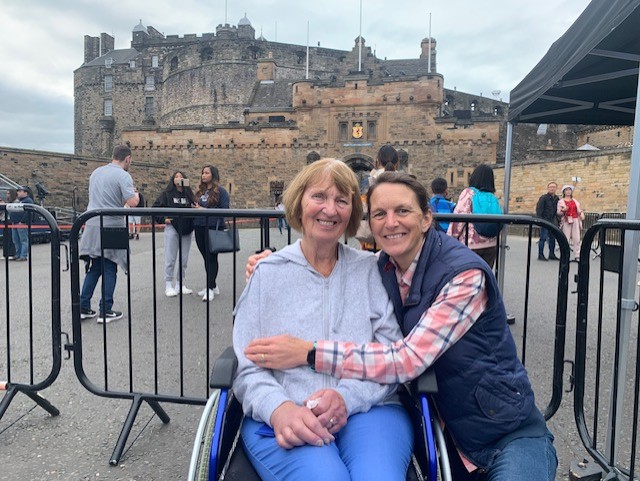 Susan with her mum, Ann, in Edinburgh following Ann's MND diagnosis.
“I saw firsthand how this devastating disease affects everyone around the individual living with it,” Susan says. “With my healthcare academic background, I was well-placed to navigate the health system and understand clinical conversations, but ultimately I was just a daughter caring for her mum, the same way so many thousands care for their loved ones with this disease each year.”
Despite the enormous challenges, Susan is determined that the story is not only one of loss. Ann continued to live meaningfully and joyfully throughout her illness, supported by family, carers, friends, her faith, and the Scottish healthcare system.
“We never talked about Mum dying from MND,” Susan says. “We talked about Mum living with MND.
Susan was determined to support her mum’s wish to get out of the house every day, right up until her final days. They visited galleries and museums, attended concerts and theatre performances, and participated in all the activities that Ann loved, even joining in wheelchair dancing at Scottish country dances.
They also found unexpected joy through art therapy. Although Ann had never considered herself artistic, she began mouth painting after losing the use of her hands.
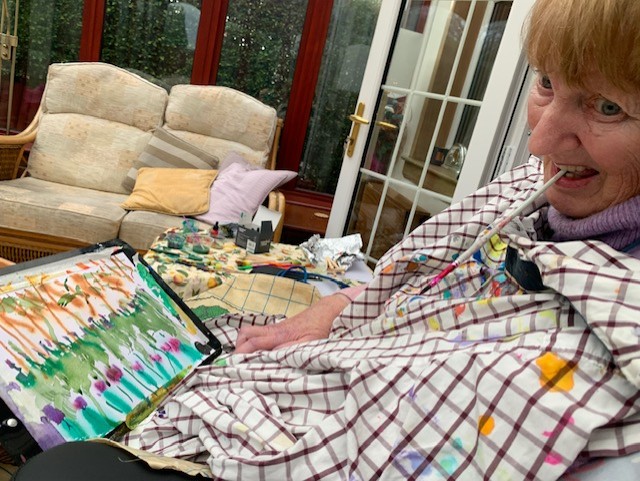 When Ann lost the use of her hands she took up painting using her mouth.
“At first, the paintings were terrible,” Susan laughs. “But then they became this incredible source of purpose and connection.”
The family eventually held exhibitions and fundraising events featuring Ann’s artwork, raising money for MND charities in Scotland. For Susan, those experiences reinforced something she now hopes to bring into MND research in Australia: the importance of quality of life.
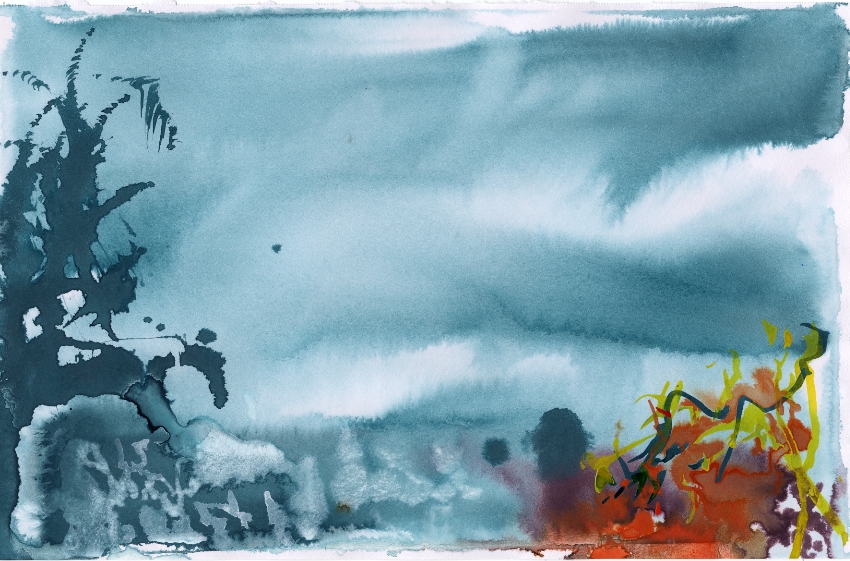 First Breath of Spring. Artwork by Ann Allan.
“Of course, we need cure research,” she says. “But while people are living with MND, we also need to understand what helps them live better.”
That belief now underpins her work at MND Australia. Susan’s work is focused on strengthening Australia’s MND data systems and building a clearer national picture of the disease. Currently, Australia still lacks comprehensive data on how many people are living with MND, survival patterns, regional differences, and the experiences of different communities.
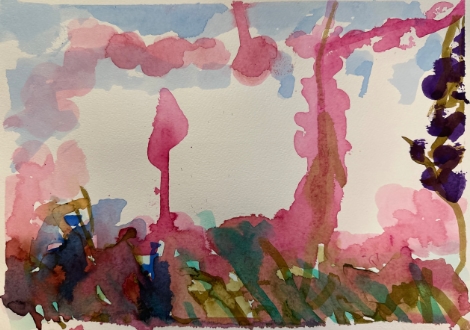 Our Day at the Botanics. Artwork by Ann Allan.
“We are building on years of incredible commitment to this disease in Australia, but there’s so much that we still don’t know,’ she says. “We need better data so we can ask and answer better questions.”
Her vision includes developing stronger national registries and research platforms that can help identify not only patterns of disease, but also what improves quality of life for people living with MND and their families.
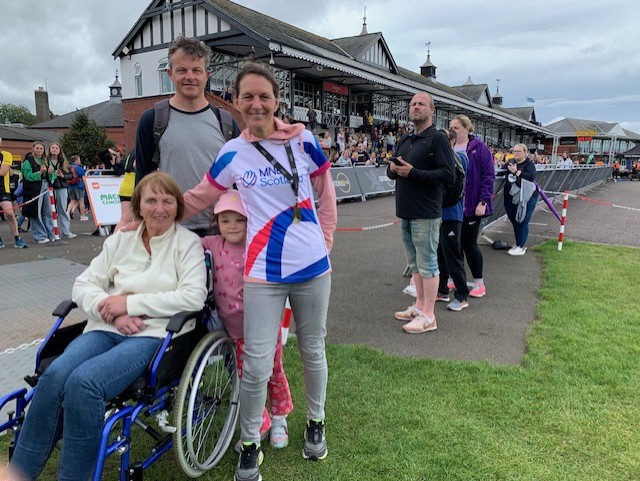 Susan, Ann and family out fundraising for MND Scotland
“What kind of support make the biggest difference? What about improving assistive technologies, counselling, or creative therapies? Susan says. “These are things we can measure and learn from.”
For Susan, the work remains deeply personal. On her desk sits a photograph of Ann smiling.
“When I look at data now, I don’t just see numbers,” she says. “I see people. I see families. And I think about how we can help change that experience for others living with MND.”
This article was originally featured in Issue 3 of Momentum magazine. Read the full magazine here.