


Motor Neurone Disease (MND) makes the muscles in your body weaker. This includes the muscles you use to breathe.
MND can affect your breathing at any stage. For some people, breathing changes are one of the first signs of MND. For others, they happen later. Changes to breathing may develop gradually over time.
There are ways to manage breathing as it becomes harder and treatments that can help you breathe better. These can improve comfort and quality of life and may also help to maintain your breathing function for longer.
Talk to your healthcare team about breathing early, even if you have not noticed any changes.
We value your feedback
After exploring the resources on this page, please complete our short survey to help us improve the information we provide.
Breathing uses muscles. The main muscle used is the diaphragm, a large muscle under your lungs. Muscles around your ribs also help you breathe.
These muscles help move air in and out of your lungs. MND can weaken them, making it harder to take a full breath, cough strongly and move enough air in and out.
Changes in your breathing muscles do not always feel like you are finding it harder to breathe (breathlessness) at first.
You may notice:
During sleep or when you wake up
waking often during the night
morning headaches
feeling unrefreshed when you wake up
feeling sleepy during the day
Breathing, speaking or coughing
difficulty taking a full breath
faster or shallower breathing
shortness of breath
finding it harder to breathe when lying flat
needing another breath after speaking fewer words
a weaker cough or sneeze.
Other changes
unusual tiredness or fatigue
reduced appetite
difficulty concentrating or feeling confused
feeling irritable or anxious.
You may not experience all of these changes.
Talk to your healthcare team early
You should not wait until breathing becomes difficult.
Ask your healthcare team about:
how your breathing will be monitored
when you should have a breathing assessment
any changes you have noticed
what breathing support may be available now or in the future.
A breathing assessment helps you and your healthcare team understand how your breathing is changing and make decisions about your care.
If you don’t already have a team, contact your state MND Association for more information.
There are ways you can support your breathing to make you feel more comfortable:
Positioning
If breathing is harder when you lie flat - sitting upright, leaning forward or using pillows may make breathing more comfortable.
Cough support
As breathing muscles weaken, coughing can become harder. A physiotherapist can suggest techniques or equipment that may help you cough and clear your airways.
Saliva management
Changes in saliva can make breathing and clearing your airways more difficult. Your healthcare team can help you manage saliva.
Breathing exercises
Your physiotherapist or respiratory team can advise whether particular breathing techniques or exercises may be useful for you.
Medicines
Some medicines may help symptoms such as breathlessness or anxiety related to breathlessness.
Talk to your healthcare team before starting or changing medicines.
A note about oxygen
Oxygen does not usually help breathing problems caused by weakened breathing muscles and may sometimes make them worse.
If you need oxygen for another health condition, use it with advice from your healthcare team.
Learn more:
Ventilation is breathing support that helps move air in and out of your lungs.
It does not stop MND or prevent your breathing muscles from becoming weaker. Ventilation can help improve symptoms such as poor sleep and breathlessness, improve quality of life and, for some people, help them live longer.
There are two main types of ventilation discussed in MND:
non-invasive ventilation (NIV) - breathing support through a mask, to make it easier for you to breathe,
tracheostomy ventilation (invasive ventilation) - breathing support through a tube placed in the windpipe, to breathe for you.
For most people with MND who need ventilation, NIV is the main form of breathing support considered.
What is NIV?
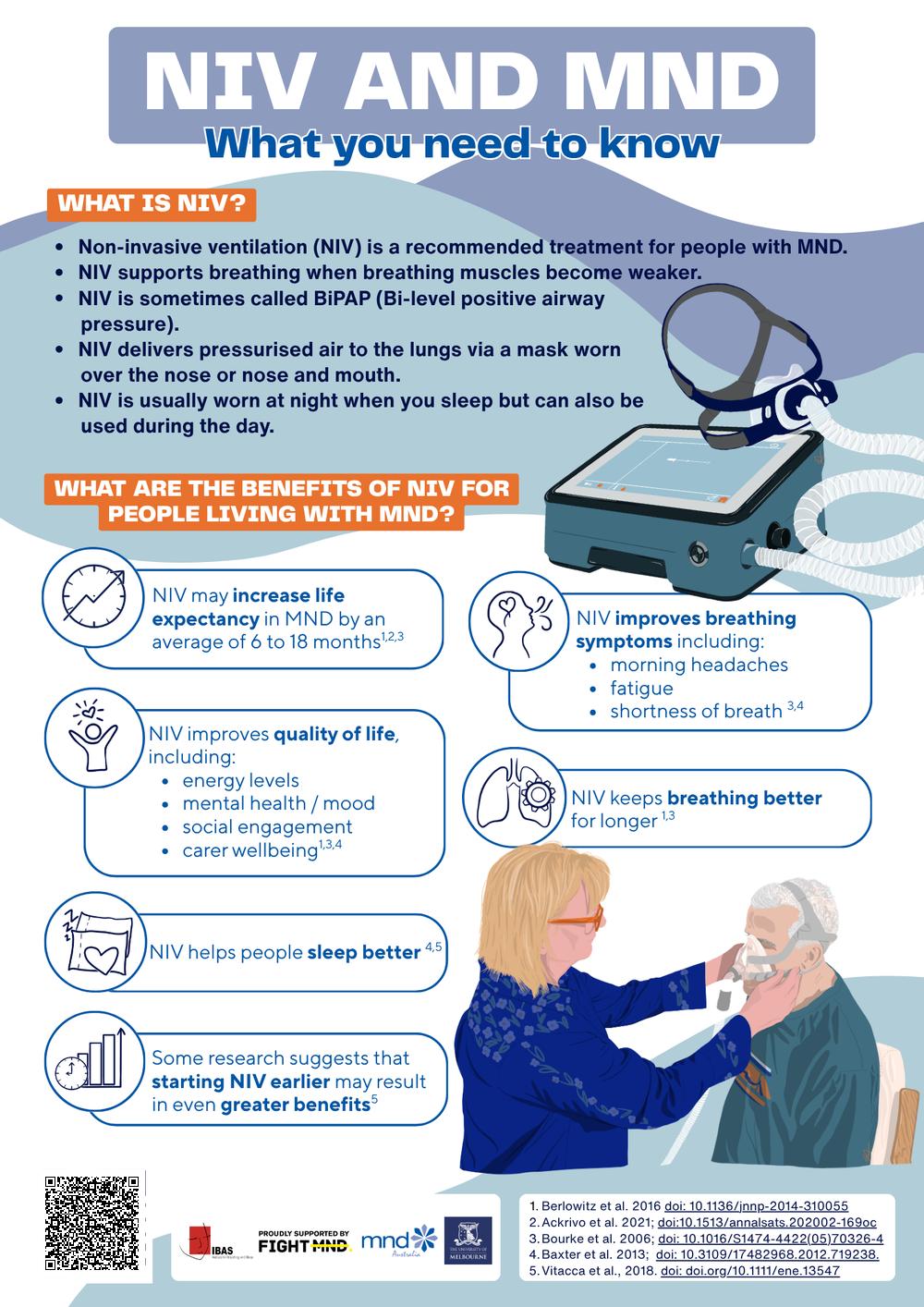
Non-invasive ventilation, usually called NIV and sometimes called BiPAP, uses a machine to support your breathing.
Air is delivered through a mask over your nose, mouth or both. This helps move air in and out and reduces the work for weak breathing muscles.
NIV does not require surgery. Ventilation can help people:
sleep better
reduce breathlessness
feel better during the day
improve quality of life
live longer.
link to NIV information/infographic sheet
Hear from clinicians, people living with MND, and their carers, about:
What is NIV? Why is it important in MND?
We value your feedback. If you watch the videos or use the question tools, please complete our short survey to help us improve these resources.
When to discuss NIV
NIV can be discussed with your health care team before you notice breathing problems, or when your breathing assessment or symptoms show changes.
Talking about NIV early gives you time to understand what it involves, ask questions and think about what matters to you.
Tips and tools for making your decision
Talking about NIV with your healthcare team is an important part of the decision-making process.
The online NIV question builder can help you think about what matters to you and helps prepare questions for your healthcare appointment. The questions you want to ask can be downloaded as a list and printed.
You can also print:
the NIV question guide – short, to take to your healthcare appointment (PDF)
the NIV question guide – long, to take to your healthcare appointment (PDF)
Hear from people living with MND and their carers about:
Journey to NIV and decision making
Deciding not use NIV
NIV is suitable for many people with MND, but it is not suitable for everyone.
There is no single decision that is right for every person. It is YOUR decision.
Your healthcare team can help you understand:
why NIV is being suggested
what benefits it may offer
possible difficulties or limitations
what using NIV could mean for everyday life
what other options may be available.
Your own preferences, goals and circumstances are an important part of the decision.
It can take time to get used to the mask and machine. Many people begin by using NIV for short periods of time.
Some people experience problems early on, such as:
the mask feeling uncomfortable or adding pressure on the face
air coming out of the mask and into the eyes
feeling uncomfortable or anxious wearing the mask.
There are different types of masks, and your healthcare team can adjust the mask or equipment to improve comfort. Over time, most people overcome these problems and NIV becomes part of their daily routine.
Hear from people living with MND, their carers, and healthcare professionals about:
Starting NIV for the first time
Becoming familiar with NIV
We value your feedback. If you watch the videos or use the question tools, please complete our short survey to help us improve these resources.
What is everyday life with NIV like?
People experience NIV differently. For some people, NIV can mean:
sleeping better
feeling less breathless
having more energy during the day.
These benefits can make everyday activities easier and help improve comfort and quality of life.
Hear from people living with MND, their carers, and healthcare professionals about:
Personal benefits of NIV
Your family, carers and healthcare team can be involved in planning how NIV fits into daily life . You may need help:
moving the equipment
putting the mask on or taking it off
maintaining the equipment
keeping your airways clear.
As your breathing needs change, you may use NIV for longer periods, including during the day. Ask your health care team for advice on what you can do to make this easier.
Hear from people living with MND, their carers, and healthcare professionals about:
Living with NIV
What if I want to stop ventilation later?
You can choose to stop using ventilation after you have started using it.
If you have become dependent on ventilation to breathe, stopping it can be life-threatening.
Respiratory and palliative care specialists can explain what would happen and provide care to manage symptoms such as breathlessness and anxiety.
Some people want to understand this possibility early. Others prefer to return to the information when it becomes more relevant.
Family members and carers may be involved in decisions about ventilation and in helping with its everyday use.
You may have questions about:
equipment and masks
daily routines
getting out and about
what to do if equipment stops working or there is a power failure
how much practical help may be needed
training and support for carers.
Ask the healthcare team what support and training are available for you and the person using NIV.
Hear from carers and clinicians about their experience of supporting someone using NIV:
NIV and impact on carers
We value your feedback. If you watch the videos or use the question tools, please complete our short survey to help us improve these resources.
Tracheostomy ventilation, sometimes called invasive ventilation, uses a machine to provide breathing support through a tube placed into the windpipe through the neck.
It may be considered if NIV is not suitable or no longer provides enough breathing support.
Tracheostomy ventilation can provide ongoing breathing support but requires surgery and significant daily care. It is not commonly used for people with MND in Australia.
If you would like to understand or consider tracheostomy ventilation, talk with your healthcare team.
If you have used any of the NIV resources - the videos, online question builder, PDF question guides or the MND and NIV information sheet - we would appreciate your feedback!
Please complete the brief survey to help us better support the MND community.
Acknowledgements
Thanks to Dr Marnie Graco and Kylie Russo from the Breathing, Exercise and Sleep Therapies (BEST) Laboratory at the Institute for Breathing and Sleep and The University of Melbourne for clinical review and guidance.
The research to develop the NIV resources was led by the Institute for Breathing and Sleep and The University of Melbourne, funded by FightMND, and the Institute for Breathing and Sleep. With special thanks to the more than 50 people from across Australia who co-developed these information resources, including people living with MND, family caregivers, healthcare professionals, and researchers.
We’re proud to be delivering projects with the support of the Peer Support and Capacity Building (PSCB) grant from the NDIA.
Thanks to the MND Association UK for permission to adapt their Information resources related to Breathing and ventilation.
Sources
Van Damme P, et al. European Academy of Neurology guideline on the management of amyotrophic lateral sclerosis in collaboration with ERN EURO-NMD. European Journal of Neurology. 2024;31:e16264. doi:10.1111/ene.16264.
National Institute for Health and Care Excellence. NICE (National Institute for Health and Care Excellence) 2016, Motor neurone disease: assessment and management NICE guideline [NG42]. (2016). 2024 surveillance.
Khan A, Frazer-Green L, Amin R, et al. Respiratory Management of Patients With Neuromuscular Weakness: An American College of Chest Physicians Clinical Practice Guideline and Expert Panel Report. Chest. 2023;164(2):394–413. doi:10.1016/j.chest.2023.03.011.
Radunovic, A., Annane, D., Rafiq, M. K., Brassington, R. & Mustfa, N. Mechanical ventilation for amyotrophic lateral sclerosis/motor neuron disease. Cochrane Database Syst. Rev. 2017, CD004427 (2017) https://pubmed.ncbi.nlm.nih.gov/28982219/
Barnett A, Beasley R, Buchan C, et al. Thoracic Society of Australia and New Zealand Position Statement on Acute Oxygen Use in Adults: ‘Swimming between the flags’. Respirology. 2022;27:262–276. doi:10.1111/resp.14218.
Andersen PM, Abrahams S, Borasio GD, et al. EFNS guidelines on the clinical management of amyotrophic lateral sclerosis (MALS) – revised report of an EFNS task force. European Journal of Neurology. 2012;19(3):360–375. doi:10.1111/j.1468-1331.2011.03501.x
McHenry KL. Airway Clearance Strategies and Secretion Management in Amyotrophic Lateral Sclerosis. Respiratory Care. 2024;69:227–237. doi:10.4187/respcare.11215.