


News
Support at Home Program Senate Inquiry
MND Australia Opening Statement
Published: 22 September 2026
Senators,
People are dying prematurely. People are ending up stuck in hospital. People are being pushed prematurely into residential aged care – if they are ‘fortunate’ enough to be accepted.
Support at Home is not fit for purpose.
It is immoral for the program to continue as it is. Most people who need Support at Home are not affluent. Some are pensioners living just above the poverty line. Some have no family to provide care.
For people with MND, they are already facing the most horrendous disease, a torrent of medical costs, the most rapid deterioration of their bodies, and the most devastating impact for themselves, their partners and families.
They need Support at Home for essentials like a toilet seat to safely use the toilet, help getting out of bed and showered.
Currently, the highest level of funding (Level 8) secures two hours a day of care. Two hours.
This probably means getting out of bed and maybe a shower. No help with toileting throughout the day. No help with clinical needs like feeding tubes or ventilation. No help with regularly turning and repositioning. No help with household chores.
Importantly, no respite for what is most often an older carer, often with their own health needs.
We want to acknowledge the Government's decision to give people with MND urgent faster access to Support at Home. But getting inadequate support faster does not solve the fundamental problem.
There are many issues plaguing Support at Home, but for the sake of time, I want to highlight four.
First: funding does not reflect the real cost of caring for someone with MND.
Glenn Rowan has advanced MND and receives the highest Support at Home package – around $78,000 a year or $1500 per week. His care costs around $8,000 a week. His family is funding most of that themselves.
Second: An allocation is meaningless if people cannot turn it into care.
Provider prices, administrative charges and barriers to essential assistive technology like non-invasive ventilation continue to erode the value of packages.
Our analysis found aged care prices for comparable services were between 24 and 94 per cent higher than NDIS pricing.
Third: Non-invasive ventilation is not covered by Assistive Technology funding.
Non-invasive ventilation is currently the only reliable way to extend life, research shows up to 18 months of life. NIV Ventilators cost approximately $5,000. Support at Home does not cover this.
And finally: The Integrated Assessment Tool isn’t working.
Of 71 people with MND whose assessments we examined, 60 per cent received Level 4 or below. This equates to about four hours a week of care. That is not even enough to shower each day.
We have broken one of our most basic social contracts: that Australians will be supported as they age. We are failing by allowing this program to continue in its current state.
But even if we decide to consider a social support on the economic arguments alone, pushing people to hospital and residential aged care, the most expensive places for people to be, just doesn’t make sense.
Support at Home is broken, and it is immoral for us not to urgently fix it.
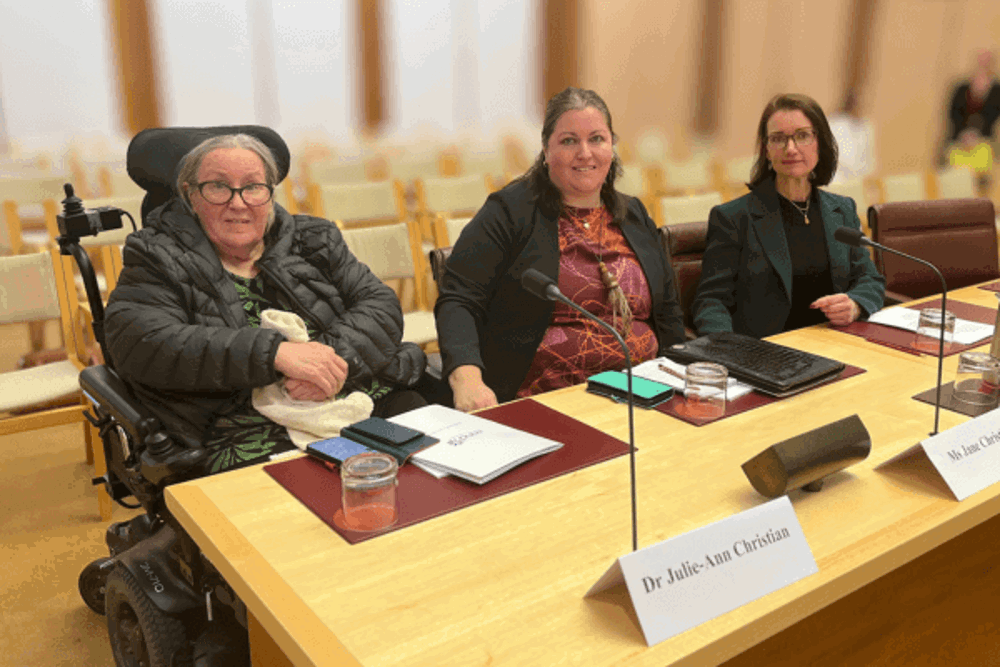
I have with me today Julie, who has MND and receives Support at Home funding, and her carer, her daughter Jayne. Julie and Jayne are proud Baramadagal women with connections to Wiradjuri Country. They can speak to the inadequacy of the package amounts, the impossibility of getting funding for ventilation, and the emotional toll of navigating a system that works against them.
Thank you.
Read MND Australia's full submission to the Support at Home Senate Inquiry